
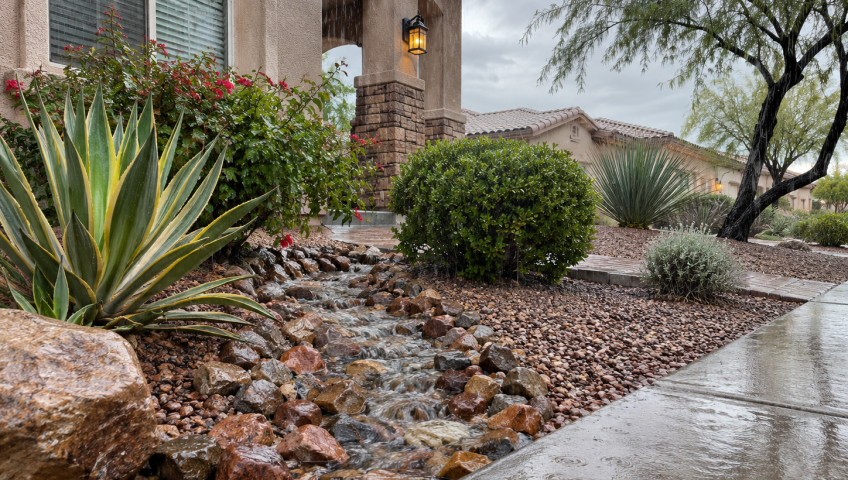
Las Vegas homeowners do not usually think about landscape drainage until water is already collecting where it should not. This fall is a good reminder that preventive drainage work matters.
The official National Weather Service station at Las Vegas recorded 1.31 inches of rain in October 2026. That was more than four times the normal October precipitation, and about 1.08 inches fell within a single 24-hour period. For a desert city, that is enough rain to expose low spots, poor grading, clogged drains and runoff paths that may stay hidden during long dry periods.
At the same time, NOAA says the current El Niño is continuing to strengthen, with a strong-to-very strong event likely through January-March 2027. NOAA’s winter outlook also tilts wetter across much of the southern United States and Southwest. Seasonal outlooks do not guarantee that every Las Vegas neighborhood will receive heavy rain, but they are a good reason to address drainage problems before the next storm instead of after damage occurs.
Homeowners can review the current NOAA El Niño discussion, NOAA winter outlook and National Weather Service Las Vegas climate data for the latest information.
If your property showed any of the warning signs below during October’s rain, Chicago Landscape can evaluate the landscape and determine whether grading or drainage improvements should be addressed before winter.
Why Las Vegas Yards Can Develop Drainage Problems
Las Vegas receives relatively little rainfall compared with many parts of the country, but that does not mean drainage is unimportant. The opposite can be true: long dry periods can allow drainage problems to go unnoticed until a concentrated storm delivers a large amount of water in a short time.
Developed properties also contain many surfaces that influence runoff. Roofs, patios, pavers, pool decks, artificial turf, block walls, driveways and compacted landscape areas can all redirect water. A backyard that looks perfectly level during dry weather may reveal a very different drainage pattern once rain starts moving across it.
Some problems are obvious, such as a large puddle against the house. Others are more subtle: washed-out decorative rock, settling pavers, soil erosion behind a wall or water repeatedly crossing the same walkway.
The best time to identify those problems is while the evidence from recent storms is still visible.
1. Water Pools Near the House, Patio or Foundation
Standing water next to a home is one of the clearest reasons to evaluate grading. The surrounding landscape should not continually direct stormwater toward the structure.
Watch areas near patio edges, side yards, door thresholds and transitions between the home and landscape. Water that remains after the surrounding yard has drained may indicate a low spot, insufficient slope or a drainage route that has been blocked by later landscape improvements.
This is particularly important when a yard has been changed over time. A new patio, paver extension, artificial turf area or raised planter can unintentionally change how stormwater moves across the property.
Chicago Landscape can evaluate the surrounding grades and determine whether the area needs to be reshaped, whether water needs a clearer surface route or whether a drainage system is appropriate.
2. Rainwater Flows Toward the House Instead of Away From It
You do not need a large puddle to have a grading problem. Watch the direction water moves while it is actively raining.
If runoff consistently travels toward the house, garage or covered patio, the existing slope deserves attention. Small grade differences can control a surprising amount of water during a strong desert storm.
This is one reason drainage planning should be considered before adding major hardscape. Pavers, concrete and other relatively impermeable surfaces can accelerate runoff and shift it toward a lower part of the property.
If you are planning a broader project, Chicago Landscape can coordinate drainage with paver installation, landscape renovation and other improvements instead of treating water flow as an afterthought.
3. Decorative Rock Has Washed Into Walkways or Low Areas
Decorative landscape rock is common throughout Las Vegas, so it often provides a visible record of where stormwater has traveled.
After a heavy rain, look for:
- Rock displaced from planting beds
- Bare soil channels through gravel
- Rock accumulating along a wall or walkway
- Mulch, leaves or debris deposited in one low area
- Small erosion channels that repeat after each storm
Those patterns show where water is concentrating. Simply raking the rock back into place may restore the appearance, but it does not correct the underlying runoff path.
On a properly planned landscape, grading and drainage should move water in a controlled direction without repeatedly washing out finished areas.
4. Pavers Are Settling, Separating or Holding Water
Paver patios and walkways depend on proper base preparation and drainage. If water repeatedly collects beneath or alongside a hardscape area, movement can become more noticeable over time.
Signs worth investigating include:
- Puddles that form in the same section of patio
- Low pavers that remain wet after surrounding areas dry
- Joint material washing out repeatedly
- Edges beginning to settle
- Water trapped between the patio and an adjacent wall or turf area
Not every uneven paver is caused by drainage, but recent rainfall can make the relationship easier to see.
Chicago Landscape installs both paver hardscape and landscape drainage solutions, which allows us to evaluate the surface and the surrounding grade together.
5. Artificial Turf Holds Water or Has Persistent Wet Spots
Artificial turf is designed to drain, but the entire installation still depends on the base, surrounding grades and a place for water to go.
If one section of synthetic turf remains saturated well after a storm, water may be collecting beneath the surface or entering the turf area faster than the base and surrounding landscape can move it away.
The problem may also be outside the turf itself. Adjacent pavers, raised landscape areas or walls can direct additional runoff into the synthetic lawn.
A drainage evaluation should look at the whole area instead of assuming the turf is the source of the problem.
6. Existing Drains Are Slow, Overflowing or Full of Debris
A drainage system only works if water can enter it and continue flowing.
Recent storms can expose problems such as:
- Surface drains filled with leaves, rock or sediment
- Drain inlets positioned above the actual low point
- Water backing up around a drain instead of entering it
- Buried drain lines that no longer move water effectively
- Older drainage routes that were interrupted by later construction
Homeowners should inspect visible drains after storms and keep openings clear. If water continues to pool even when an inlet is unobstructed, the larger system may need evaluation.
7. Soil Is Eroding Around Slopes, Walls or Planting Areas
Erosion is not limited to large hillsides. Even modest grade changes in a Las Vegas yard can concentrate runoff.
Look for exposed roots, washed soil, small gullies, undermined edging or sediment collecting below a slope. Repeated erosion can affect planting areas and can also move material onto patios, walkways and neighboring sections of the landscape.
Correcting the problem may involve reshaping the grade, slowing the flow, redirecting water or adding drainage infrastructure depending on the property.
This is especially important before installing new landscape rock. Fresh rock can hide the underlying soil temporarily, but it will not solve an active runoff problem.
8. Water Collects Behind Walls or Between Landscape Zones
Retaining walls, decorative walls, pool decks, turf borders and paver edges can create boundaries that change water movement.
After a storm, look for narrow strips of standing water along these transitions. Water that repeatedly becomes trapped behind a wall or between two materials often indicates that the area lacks a sufficient outlet.
Chicago Landscape regularly designs yards with multiple landscape surfaces, so drainage is considered in relation to the entire layout: pavers, turf, rock, walls, planting and outdoor-living spaces.
9. Your Yard Had a Problem During October’s Rain—even If It Looks Fine Now
This may be the most important sign of all.
If water entered a patio, pooled against the house, washed out rock, crossed a walkway or created erosion during the October storms, do not assume the problem disappeared because the yard is dry today.
October gave Las Vegas homeowners a useful real-world drainage test. The official airport station received 1.31 inches for the month, including more than an inch during a single 24-hour period. Your neighborhood’s exact rainfall may have differed, but any visible drainage failure on your property is worth documenting.
Take photos of the water path, high-water marks, erosion and standing-water areas. Those images can be extremely useful during a landscape drainage consultation because they show what happens while the storm is active.
Strong El Niño Makes Prevention More Important This Winter
NOAA’s October 8 ENSO discussion states that El Niño continues to strengthen and that a strong-to-very strong El Niño is likely through January-March 2027. NOAA’s October 15 winter outlook says the event increases the odds of wetter-than-average conditions across much of the southern United States, including the Southwest.
That does not mean Las Vegas is guaranteed to receive a specific amount of rain this winter. Seasonal outlooks describe probabilities across broad regions, not individual properties or individual storms.
What they do provide is a reason to be preventive.
If your yard already demonstrated a drainage weakness during this fall’s rain, waiting for another major storm offers very little benefit. Drainage and grading problems are generally easier to evaluate and plan before water is actively threatening patios, landscaping or structures.
What Chicago Landscape Can Do for a Drainage Problem
Chicago Landscape provides grading and drainage services in Las Vegas and Henderson. The correct solution depends on how water enters the property, where it travels and where it can be safely directed.
A project may involve:
- Evaluating existing grades and stormwater flow
- Correcting low areas or improper slopes
- Regrading sections of the landscape
- Installing or improving surface drainage
- Installing subsurface drainage where appropriate
- Coordinating drainage with pavers, artificial turf, landscape rock or planting
- Correcting drainage as part of a larger backyard or front-yard renovation
The goal is not simply to make a puddle disappear. The goal is to understand why water is collecting there and create a practical path for runoff.


Do a Simple Drainage Walk-Through Before the Next Storm
You do not need special equipment to perform a useful first inspection.
Walk the property and look for visible evidence left by the last storm. Check the side yards, patio edges, low spots around turf, landscape-rock beds, wall lines, drains and transitions between different surfaces.
Then ask a simple question: If another inch of rain arrived quickly, where would the water go?
If the answer is toward the house, into a low patio, behind a wall or into an area that already flooded in October, it is worth addressing before winter.
For a professional evaluation, contact Chicago Landscape and schedule a free on-site consultation.
Chicago Landscape Drainage & Grading FAQ
Can Chicago Landscape inspect a Las Vegas yard that flooded or pooled during the recent rain?
Yes. Chicago Landscape can evaluate the property’s grades, visible runoff paths, low areas, existing drains and surrounding landscape features. Photos or video taken while water was actively pooling can also help us understand what happened during the storm.
Does Chicago Landscape install subsurface or French-drain-style drainage systems?
Yes. Chicago Landscape has completed subsurface drainage work in the Las Vegas Valley, including projects in Summerlin and Henderson. The appropriate drainage method depends on the site, grades, water source and available discharge route, so the property should be evaluated before choosing a specific system.
Can Chicago Landscape correct drainage while installing pavers or artificial turf?
Yes. Drainage is best considered before new hardscape or turf is installed. Chicago Landscape can evaluate grades and runoff while planning pavers, artificial turf, rock and other landscape improvements so the finished project works as a complete system.
Does Chicago Landscape regrade yards in Las Vegas and Henderson?
Yes. Regrading can be part of a drainage solution when existing slopes or low areas are contributing to the problem. The amount of grading required depends on the property and how water needs to move through the landscape.
Should I wait for another heavy storm before calling Chicago Landscape?
If the recent October rain already revealed pooling, erosion or runoff toward the house, there is usually no advantage to waiting for another storm to confirm the problem. Document what happened and schedule an evaluation while the evidence is still easy to identify.
Can Chicago Landscape fix drainage as part of a complete backyard redesign?
Yes. Drainage can be incorporated into a larger landscape renovation that includes pavers, artificial turf, decorative rock, planting, walls, lighting and other outdoor-living improvements. Addressing water flow during the design stage can prevent new features from creating or worsening drainage problems.
Prepare Your Las Vegas Landscape Before Winter Storms
The October rain already showed many Las Vegas homeowners exactly where water travels across their property. With NOAA forecasting a strong-to-very strong El Niño into winter, this is a good time to correct known drainage problems instead of waiting for the next heavy storm.
Chicago Landscape of Las Vegas serves homeowners and commercial properties throughout Las Vegas and Henderson. We are an A+ BBB Rated, licensed and insured Nevada C-10 landscape contractor and an SNWA Water Smart Contractor.
We offer FREE on-site consultations for grading, drainage, pavers, artificial turf, landscape renovations and complete outdoor-living projects.
Contact Chicago Landscape of Las Vegas to schedule a drainage and grading consultation before the next winter storm.