
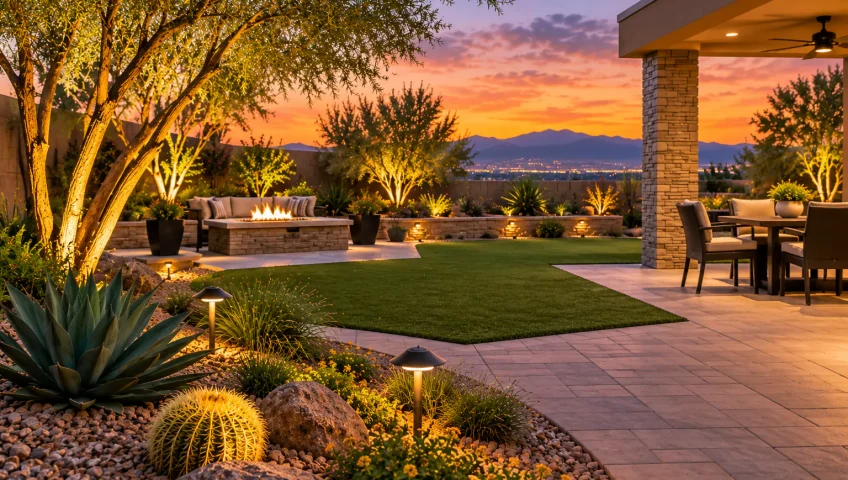
Here are nine practical ideas for upgrading a Las Vegas landscape lighting plan for the cooler season.
1. Light Walkways and Changes in Elevation First
Before focusing on dramatic accent lighting, make sure people can move comfortably through the property after dark. Walkways, steps, retaining-wall transitions, driveway edges, and changes in elevation are some of the most important areas to illuminate.
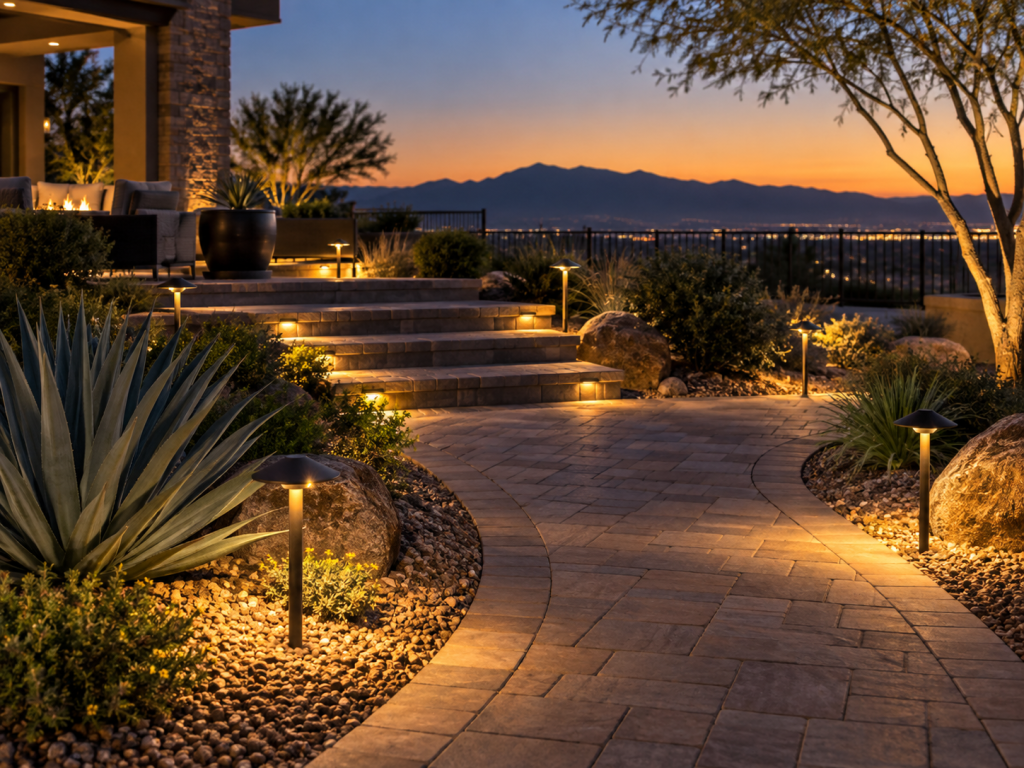
Low-level path lights can help define circulation without creating harsh glare. The goal is not to flood the walkway with light, but to provide enough visual guidance to understand where the path goes and where elevation changes occur.
For paver patios and walkways, lighting can also be incorporated into nearby planting beds or hardscape features so fixtures do not interrupt the clean design of the surface.
2. Use Uplighting to Showcase Desert Trees
Mature trees can become some of the most dramatic visual features in a Las Vegas yard after dark. Carefully positioned uplights can emphasize trunks, branching patterns, and canopy structure while creating depth across the landscape.
Good candidates may include palo verde, mesquite, desert willow, acacia, and other specimen trees. The exact lighting angle should depend on the tree’s form and location.
Too much brightness can flatten the scene and create glare, so subtle lighting generally looks more refined than a high-output floodlight.
If you are considering adding new trees as part of a landscape upgrade, our guide to the best trees to plant in Las Vegas can help with plant selection.
3. Highlight Architectural Features, Not the Entire House
Landscape lighting can reinforce the architecture of a home when it is aimed selectively. Stone columns, textured walls, entry features, pergolas, courtyard walls, and other distinctive elements can become strong focal points after dark.
Instead of washing every exterior wall with the same intensity, use smaller pools of light to create contrast. That makes the property feel layered and intentional.
Directional fixtures can also be used to graze textured stone or masonry, producing shadows that make the material more visible at night.
4. Create a Separate Lighting Zone for Patios and Seating Areas
Patios need different lighting than pathways or landscape beds. The objective is to make conversation, dining, and entertaining comfortable without shining bright light directly into people’s eyes.
A well-designed patio may combine:
- Low-level perimeter lighting
- Downlighting from patio covers or structures
- Accent lighting on nearby plants and trees
- Step or wall lighting
- Task lighting near grills or outdoor kitchens
Separating patio lighting into its own control zone can also make it easier to adjust the environment depending on whether the space is being used for dining, entertaining, or simply relaxing.
5. Light Outdoor Kitchens for Function, Not Just Appearance
Outdoor kitchens, BBQ areas, and wet bars require practical task lighting. Cooking surfaces, counters, sinks, and food-preparation areas need enough illumination to be used safely after dark.
That functional lighting should be coordinated with the surrounding landscape lighting so the kitchen does not look like an isolated bright box in an otherwise dark yard.
If your outdoor kitchen is part of a larger backyard renovation, integrating the lighting during design is usually cleaner than adding fixtures after construction is complete.
Explore our custom outdoor kitchen and BBQ services for more ideas.
6. Use Warm, Controlled Light Instead of Harsh Blue-White Light
Responsible outdoor lighting is not simply about brightness. DarkSky International and the Illuminating Engineering Society recommend outdoor lighting that is useful, targeted, low-level, controlled, and warm-colored.
For residential landscapes, warmer light generally creates a more comfortable atmosphere around patios, stone, desert plants, and architectural materials. It can also reduce the cold, commercial look that sometimes comes from very bright blue-white fixtures.
Timers, dimmers, and other controls can also help ensure lighting is used only when it is needed.
For current guidance, see the Five Principles for Responsible Outdoor Lighting.
7. Add Depth by Lighting Multiple Layers of the Landscape
One of the biggest differences between basic outdoor lighting and professional landscape lighting is depth.
If every fixture is installed along the edge of the house, the yard can disappear into darkness beyond the patio. Lighting selected plants, walls, trees, or structures farther into the property creates visual layers and makes the yard feel larger at night.
A layered lighting plan may include:
- Foreground path or planting-bed lighting
- Mid-yard specimen plants or hardscape accents
- Background trees or walls
- Architectural lighting near the home
The result is a landscape that can be appreciated from inside the home as well as from the patio.
8. Integrate Lighting With Fire Features
Fire pits and fire tables naturally become focal points during cooler Las Vegas evenings. Landscape lighting should support the atmosphere created by the flame rather than overpower it.
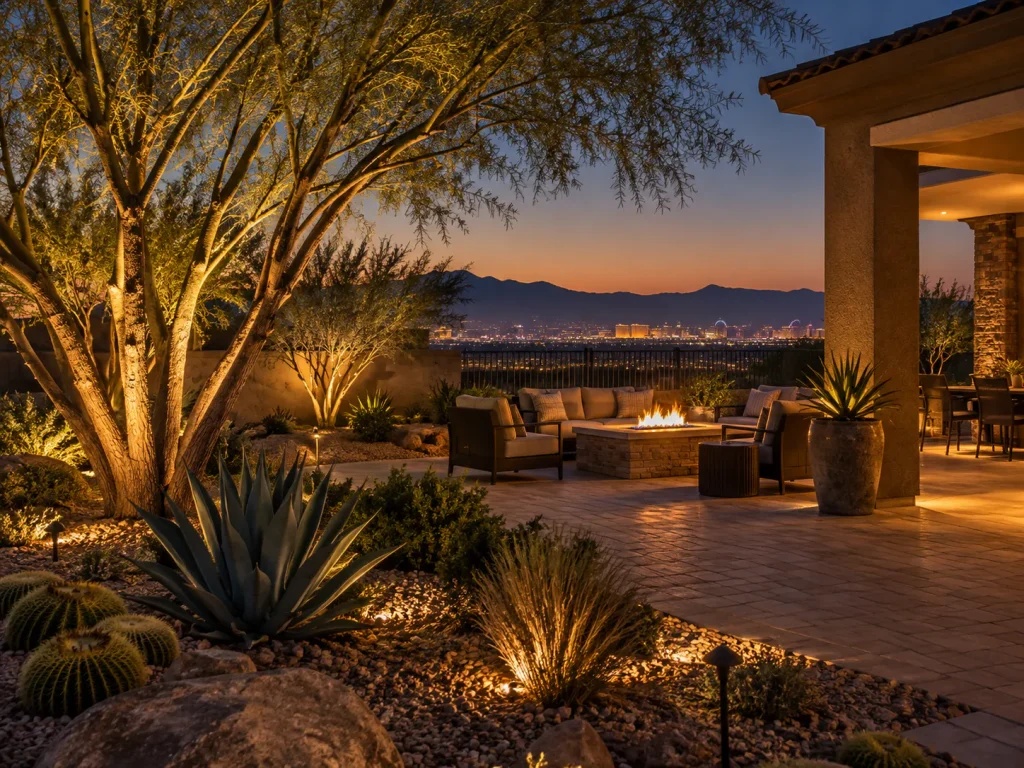
Low-level lighting around nearby steps, seating edges, plant beds, and pathways can provide enough visibility to move around safely while allowing the fire feature to remain the visual center of the space.
This is another reason dimmers and separate lighting zones can be useful. A patio may need brighter light during dinner and much softer lighting later in the evening.
9. Design the Lighting Before the Landscape Is Finished
If you are planning a new backyard, desert conversion, paver installation, retaining wall, or outdoor living project, include landscape lighting in the design phase rather than treating it as an add-on.
Planning early makes it easier to:
- Route low-voltage wiring cleanly
- Position transformers and controls
- Place fixtures before rock or hardscape is complete
- Coordinate lighting with trees and mature plant sizes
- Integrate lighting into walls, steps, or structures
- Avoid disturbing finished landscaping later
If you are planning a larger project, our article on fall landscape renovations in Las Vegas explains why cooler-season planning and installation can be especially practical.
Common Landscape Lighting Mistakes to Avoid
Using Too Many Fixtures
More fixtures do not automatically create a better design. Excessive lighting can remove contrast and make the property feel flat.
Pointing Fixtures Toward Windows or Seating Areas
Glare can quickly make an otherwise attractive lighting system uncomfortable. Fixtures should be aimed carefully and shielded where appropriate.
Ignoring Mature Plant Growth
A fixture that works perfectly beside a small shrub may be completely blocked once the plant matures. Lighting and plant placement should be coordinated.
Using One Switch for Everything
Separate zones provide more flexibility. Path lighting, patio lighting, architectural accents, and trees do not always need to operate at the same intensity or at the same time.
Forgetting Maintenance Access
Fixtures should remain accessible for adjustment, cleaning, and future landscape changes.
Frequently Asked Questions About Landscape Lighting in Las Vegas
Is low-voltage landscape lighting good for Las Vegas homes?
Yes. Low-voltage systems are commonly used for residential path, accent, tree, patio, and landscape lighting because they allow flexible fixture placement and controlled illumination throughout the yard.
What areas should be lit first?
Prioritize walkways, steps, changes in elevation, entries, and frequently used outdoor living areas. Decorative accent lighting can then be added around trees, walls, and other focal points.
Should landscape lights stay on all night?
Not necessarily. Timers, smart controls, dimmers, and motion-based controls can reduce unnecessary operation while keeping important areas illuminated when they are being used.
What color temperature is best for landscape lighting?
Warm-colored lighting generally creates a softer residential appearance and aligns with responsible outdoor-lighting guidance that recommends minimizing unnecessary blue-rich light.
Can lighting be added to an existing landscape?
Yes. Existing yards can often be retrofitted with landscape lighting, although installation is usually easier when wiring and fixture locations are coordinated with a new landscape or hardscape project.
Professional Landscape Lighting Design in Las Vegas
The best landscape lighting Las Vegas homes use is designed as part of the entire outdoor environment. Plants, hardscape, pathways, architecture, patios, and outdoor living areas should work together after dark just as they do during the day.
Chicago Landscape of Las Vegas can incorporate lighting into new landscape installations, desert conversions, backyard renovations, paver projects, outdoor kitchens, and complete outdoor living designs.
- FREE on-site landscape consultations
- A+ BBB Rated Business
- Licensed and insured Nevada C-10 landscaping contractor
- SNWA Water Smart Contractor
- Landscape lighting design and installation
- Desert landscaping and planting
- Paver patios and walkways
- Outdoor kitchens and fire features
- Complete front and backyard redesigns
Learn more about our Las Vegas outdoor lighting services, or contact Chicago Landscape of Las Vegas to schedule a free on-site consultation.
Make your landscape as useful and attractive after sunset as it is during the day.
Want More Las Vegas Landscaping Tips?
Add Chicago Landscape of Las Vegas as a Preferred Source on Google to see more of our local landscaping guides, project updates, and expertise in Search and AI results.